

According to the shadow work and pensions secretary Liz Kendall, under a Labour government there would be “no option of a life on benefits”. Labour’s is targeting the NEETs, (young people Not in Education, Employment or Training’). Figures announced at the end of February show the percentage of all young people who were NEET in October to December 2023 estimated at 12.0% of all 16–24-year-olds, up 0.2 percentage points on October to December 2022.
The total number of people aged 18 to 24 years who were NEET was 785,000, (14.2%) up 19,000 on the previous year (there shouldn’t really be any 16–17-year-old NEETs as young people are required to be in either education or employment with training until they are 18!). Only around 300,000 of 18-24 NEETs are officially unemployed, but, a similar amount recorded as sick. ( see previous post on the high rates of mental health issues). Though employment as a whole in recent months, has remained robust, with high levels of vacancies in some sectors. As the chart below shows, the number of NEETs has edged upwards.
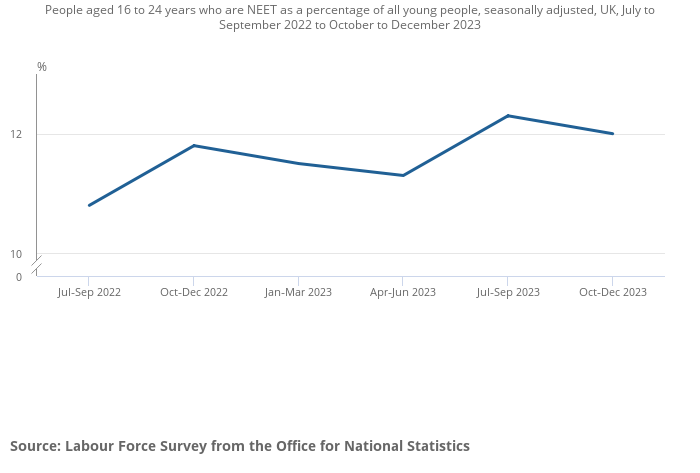
As part of its plans to ‘invest’ in young people, Kendall said the party would recruit 8,500 more mental health workers and 1000 more careers advisors. Kendall told the BBC that ‘in return’ young people would be ‘expected to work’. But even if these numbers were reached, it would be a short-term fix. Without major changes in economic conditions and labour market opportunities, a general feeling of despondency, disillusionment and helplessness will continue to creep across generation Z.

The hostility towards the NEETs is reminiscent of the government and tabloid press wrath about young people’s opposition to the youth training schemes (YTS) of 40 years ago, established in response to rising youth unemployment. But even in the Thatcher years, considered to be the catalyst (if not the cause) for continued deindustrialisation, the number of ‘middle’ managerial /professional jobs were still expanding sufficiently for enough working-class young people to move into them; though the ‘old’ apprenticeships in manual trades were giving way to full-time vocational courses in schools and colleges.
Now, unless you are graduating from the small group of elite Russell plus universities, the risk of precarious employment in the lower paid parts of the service sector stares you in the face. And there continues to be an absence of ‘new’ apprenticeship opportunities with only 1 in 3 apprentice starts by a person under 19. (Budget announcements about altering the name and the way the employer levy is administered won’t change this.)
If thousands of university students remain highly stressed and prone to an array of mental health conditions (this academic year saw the number of applications from UK school and college leavers go into reverse) as they join the scramble for disappearing graduate jobs, according to a Barnardo’s survey, half of 14-17 years also don’t think they’ll be as well off as their parents by the time they get to 30. According to surveys, 1 in 5 secondary students are regularly absent.
But going after the NEETs fits the economic model promoted by both major political parties. Unable (or rather unwilling because of self-imposed ‘fiscal rules’ about reducing the ratio of national debt to GDP) to spend big on infrastructure (to do this you’d need to increase the size of the ‘debt’) and leaving major questions about investment in new technology to the private sector giants, productivity increase, the creation of large numbers of high skilled ‘lovely jobs’ will be unlikely. So the only way the economy can ‘grow’ (apart from getting people to work even longer hours) is by adding to the size of the labour force and creating low-paid ‘lousy jobs’.
With polls showing only about I in 10 under 25s planning to vote for the Tories, Labour obviously thinks it can get away with a lack of any real policies for them. But young people may be the real election ‘elephant in the room’ – will they vote at all?

 Education, Economy and Society
Gre