
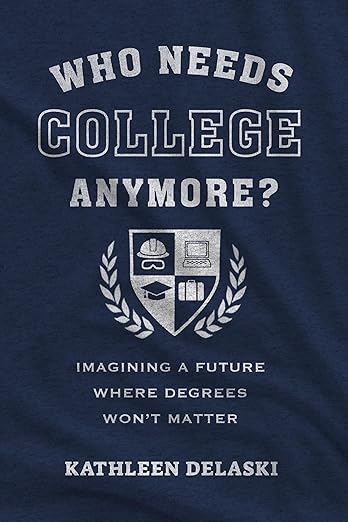
Review: Who Needs College Anymore? Imagining a Future Where Degrees Won’t Matter Kathleen Delaski, Harvard Education Press.
Post-16 Educator No 120 https://post16educator.org.uk/
Kathleen Delaski’s provocative book has received considerable attention in the US. Her basic argument is that the ‘college for all’ post-high school model of US education doesn’t serve the needs of the majority, that it’s too expensive and neither is it possible for everybody to attend. There should be alternative pathways to the college based three- or four-year degree route, for example, apprenticeships, skills boot camps and short courses linked to specific employment openings.
Advances in learning technologies and AI now enable individuals to progress through building up and extending ‘skills wallets’ (perhaps there’s a similarity with the ‘Record of Achievement’ (RoA) that became increasingly popular in UK upper secondary and further education?) Colleges should be transformed into places where new ‘micro-credentials’ can be offered – her survey results showing a majority would prefer to access labour market opportunities through non-degree qualifications.
While her arguments and evidence sources are specific to the US, there are parallels with the UK where the number of professional and managerial occupations requiring degrees continues to increase (Delaski, like many others, labelling this ‘degree inflation’) and where approaching 40% of school leavers sign up to a university system that has expanded dramatically in the last forty years, despite huge individual costs to young people – one recent estimate putting the average student debt at £58 000.
While mass university attendance has generally been considered a positive development, even if university bosses furiously compete to increase the number of ‘bums on seats’, it’s also been argued that this has come at the expense of ‘intermediate’ or ‘generic’ skills. As a result, in recent decades, alternative vocational pathways have been established. Under the last government for example, new technical qualifications (T-levels) were introduced in England with new higher-level awards planned for FE. Meanwhile, universities not considered to provide ‘value for money’ have been put under financial pressure to provide courses with a more direct vocational fit.
Delaski’s emphasis on ‘skills not schools’ will be welcomed by those who continue to promote the benefits of vocational and more practical types of learning compared to academic study. Her arguments about how learning has become institutionalised and where progress requires attending more classes, also resemble those of the 1970s ‘de-schoolers’ (though in a different context; as for Delaski education’s role is essentially an economic one, she’s just critical of the way in which this ‘human capital’ is amassed).
But it’s difficult to match credentials with specific employment skills and arguably, work skills are generally learnt ‘on the job’ rather than in the classroom. As the current generation of computer science graduates will know, they also change and evolve much faster than syllabuses and course specifications can be rewritten. But in England and in other parts of Europe, governments have tried to improve the status of vocational education by ‘standardising’ rather than diversifying, in the way Delaski recommends.
Arguably, knowing very little about what happens in classrooms, employers have used educational credentials as ‘proxies’ They’ve relied on educational institutions to select future employees for them. Delaski argues that her alternatives are more effective and enable ‘oven ready’ candidates to be available. She argues that more and more US colleges are moving in this direction. As a result, the pressure is on for them to become much looser, though more inclusive institutions.
But the way in which educational institutions select young people for future economic roles in society reflects the deeper power structures in society, rather than simply ‘economic fit’. Sociologists have long recognised the importance of education as ‘cultural capital’ and how powerful groups both define, but also seek to restrict its availability to others.
For years, progressive educators have sought to broaden the school curriculum (by promoting ‘working class’ knowledge) but with limited success, while vocational education has never really enjoyed anywhere near parity with the more theoretical, but abstract understanding of ‘learned’ or ‘scholarly’ knowledge. Worse still, rather than being an ‘alternative’, vocational learning has been used as a way of restricting access to the academic track. In otherwords it’s associated with educational failure.
Meanwhile, top employers continue to recruit potential employees from elite selective universities rather than on the technical aspects of what’s been studied – there’s no evidence, that the dominance of the US Ivy (and in this country, the top Russells) is loosening. Prestigious professional bodies have also, in most cases and at least till fairly recently, been reluctant to accept entrants who’ve followed unconventional routes.
Rather than challenging elite self-recruitment, Delaski is more concerned with trying to save increasingly financially hard up ‘middle’ American families from the expense and the accumulated debt of having to put their offspring through full-time college education. But she also accepts that traditional degree routes should continue to be available for those still wanting to follow this route – and that ‘going to college’ (as with ‘going to uni’ in the UK,) is still something many parents still think their children need to have.
If there’s anything that could undermine college culture in the US and burst the university bubble in the UK, it’s wider changes in the relationship between education and the occupational structure; with the disappearance, or at least the hollowing out of many of many ‘graduate’ roles. The US Federal Reserve reported earlier in the year that the recent college graduate unemployment rate jumped to 5.8 percent during the first quarter of 2025, compared to 4.5 percent this time last year, with the ‘underemployment’ rate (where graduates are forced to ‘trade down’ into lesser paid work) also rising to 41.2 percent. Studies in the UK also point to the gradual reduction in the ‘graduate premium’ – comparative graduate/non graduate earnings.
Yet UCAS figures show that record numbers of UK 18-year-olds have accepted a place on a full-time first degree course at university in 2024, including record numbers of those from the most disadvantaged backgrounds. Arguably many students still consider there is more to obtaining a degree than just its labour market exchange value?

 Education, Economy and Society